
Researchers from the Hefei Institutes of Physical Science of the Chinese Academy of Sciences (CAS), in collaboration with researchers from the Institute of Semiconductors of CAS, revealed anomalous oscillatory magnetoresistance in an antiferromagnetic kagome semimetal heterostructure and directly identified its corresponding topological magnetic structures.
The results were published in Advanced Functional Materials.
Antiferromagnetic kagome semimetals, characterized by a strong interplay of geometric frustration, spin correlations, and band topology, have emerged as a promising platform for next-generation antiferromagnetic topological spintronics.
In this study, the researchers fabricated an FeSn/Pt heterostructure based on an antiferromagnetic kagome semimetal. By breaking inversion symmetry at the interface, the researchers introduced and tuned the Dzyaloshinskii–Moriya interaction, enabling effective control of spin configurations in the FeSn layer.
Macroscopic transport measurements revealed that FeSn/Pt heterostructures with a specific FeSn thickness exhibit unconventional, damped oscillatory magnetoresistance in the low-field regime. This behavior is clearly distinct from conventional Shubnikov–de Haas oscillations.
Real-space magnetic force microscopy (MFM) imaging, performed using a home-built low-temperature, high-magnetic-field MFM developed at the Steady High Magnetic Field Facility (SHMFF), directly revealed a variety of topological magnetic textures in the heterostructure. These observations establish a direct correlation between the anomalous low-field magnetoresistance and antiferromagnetic topological spin textures.
Beyond providing new experimental insights into the formation mechanisms and transport responses of topological magnetic structures in antiferromagnetic kagome semimetals, this work lays an important physical foundation for the design and functional control of skyrmion-based spintronic devices in antiferromagnetic material systems.
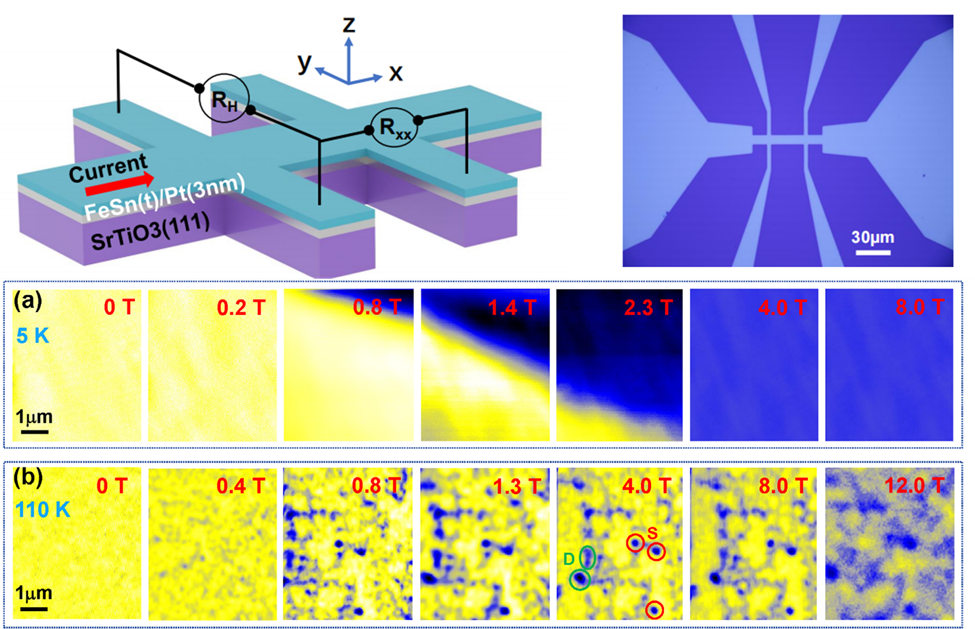
The low-field magnetoresistance oscillations originate from magnetoelectric coupling associated with topological spin textures. (Image by FENG Qiyuan)

A research team led by HAN Yuyan from the Hefei Institutes of Physical Science, in collaboration with Prof. LIU Xiansong's group from Anhui University, conducted a systematic investigation of the physical properties of semiconductor-type EuMnSb2 single crystals.

86-10-68597521 (day)
86-10-68597289 (night)

52 Sanlihe Rd., Xicheng District,
Beijing, China (100864)
Copyright © 2002 - Chinese Academy of Sciences


